
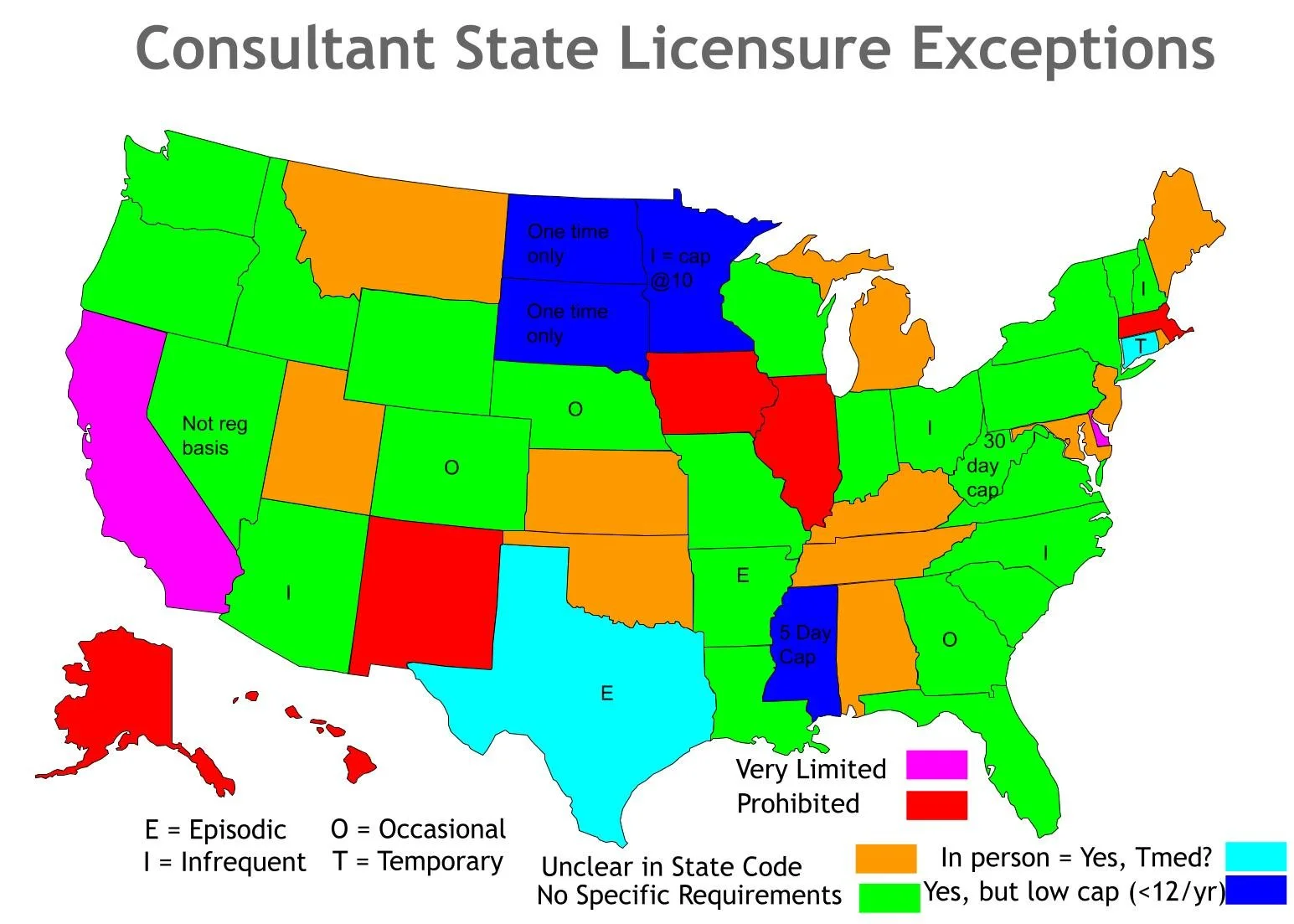
Primary care physicians commonly seek the advice of a specialty consultant. Consultant physicians often provide this advice via telemedicine. Traditionally to establish a treatment relationship with a patient the consultant physician must also be licensed in the state where the patient is located (assuming the patient is not willing/able to travel TO the consultant). If the specialist is interested in seeing the patient via telemedicine along with the primary care physician (this could often be a three way conversation for DPC practices), then there are many states where the consultant does not need to have a license in the state where this patient is located. This page of DPC Frontier represents my ongoing effort to summarize language from state medical practice acts regarding this common hypothetical. If you notice an oversight about your state or have additional information please contact me, especially if your state is “unclear” or orange in the map.
Alabama - Unclear. I am unable to locate any details on this topic in Section 34-24-50 of the Alabama Medical Practice Act.
Alaska - Prohibited. Alaska does have a courtesy license process, but it still requires a formal application and fee as described in 12 AAC 40.045 (page 22 of this 53 page file).
Arizona - Permitted. See Arizona Revised Statutes Article 32-1421. Exemptions from licensing requirements:
B. This article does not apply to:
1. A doctor of medicine residing in another jurisdiction who is authorized to practice medicine in that jurisdiction, if the doctor engages in actual single or infrequent consultation with a doctor of medicine licensed in this state and if the consultation regards a specific patient or patients.
2. A doctor of medicine who is licensed to practice in another jurisdiction if the doctor engages in the practice of medicine that is limited to patients with whom the doctor has an already established doctor-patient relationship and who reside outside this jurisdiction when both the doctor and the patient are physically in this state for not more than sixty consecutive days. For the purposes of this paragraph, "patient" means a person who is not a resident of this state and who is an athlete or a professional entertainer.
Arkansas - Permitted. See the Arkansas Medical Practices Act Statutes and Rules 17-95-206 (on page 43 of 208). Out-of-state physicians.
(a) “A physician who is physically located outside this state but who through the use of any medium, including an electronic medium, performs an act that is part of a patient care service initiated in this state, including the performance or interpretation of an X-ray examination or the preparation or interpretation of pathological material that would affect the diagnosis or treatment of the patient, is engaged in the practice of medicine in this state for the purposes of this chapter and is subject to this chapter and to appropriate rules promulgated by the Arkansas State Medical Board.
(b) This section does not apply to:
(1) The acts of a medical specialist located in another jurisdiction who provides only episodic consultation services;
(2) The acts of a physician located in another jurisdiction who is providing consultation services to a medical school;
(3) Decisions regarding the approval of coverage under any insurance or health maintenance organization plan;
(4) A service to be performed which is not available in the state;
(5) A physician physically seeing a patient in person in another jurisdiction; or
(6) Other acts exempted by the board by rule.”
California - Permitted, but narrow and complicated so that it will mostly NOT apply to DPC physicians and patients. See Business and Professions Code - BPC DIVISION 2. HEALING ARTS [500 - 4999.202] CHAPTER 5. Medicine [2000 - 2529.8.1] ARTICLE 3. License Required and Exemptions [2050 - 2078].
“2052.5. (a) For purposes of this section, the following definitions apply:
(1) “Eligible patient” means a person who meets all of the following requirements:
(A) Has an immediately life-threatening disease or condition as defined in Section 111548.1 of the Health and Safety Code. [“Immediately life-threatening disease or condition” means a stage of disease in which there is a reasonable likelihood that death will occur within a matter of months.]
(B) Has given written informed consent for, or, if the person lacks the capacity to consent, their legally authorized representative has given written informed consent on their behalf for, both of the following:
(i) The use of an eligible out-of-state physician and surgeon’s telehealth health care services.
(ii) The release of certified medical records to their primary physician and surgeon by the out-of-state physician.
(C) Has not been accepted to participate in the clinical trial nearest to their home for the immediately life-threatening disease or condition identified in subparagraph (A) within one week of completion of the clinical trial application process, or, in the medical judgment of a physician and surgeon described in paragraph (3), it is unreasonable for the patient to participate in that clinical trial due to the patient’s current condition and stage of disease.
(D) Has documentation from their primary physician and surgeon attesting that they meet the requirements in subparagraphs (A), (B), and (C). The primary physician and surgeon may withdraw the documentation if there is a substantial change in the patient’s mental capacity to make informed decisions for their own care unless their legally authorized representative has given written informed consent on their behalf.
(2) “Eligible out-of-state physician and surgeon” means a person who is licensed as a physician and surgeon in another state in good standing with no history of prior discipline, and whose medical expertise is that of the eligible patient’s illness.
(3) “Primary physician and surgeon” means a physician and surgeon licensed under the Medical Practice Act (Chapter 5 (commencing with Section 2000)) or an osteopathic physician and surgeon licensed under the Osteopathic Act (Article 21 (commencing with Section 2450)).
(4) “Telehealth” has the same meaning as provided in Section 2290.5.
(b) Notwithstanding any other law, an eligible out-of-state physician and surgeon may practice medicine in the state if the practice is limited to delivering health care via telehealth to an eligible patient.”
Colorado - Colorado Medical Practice Act 12-240-107. Practice of medicine defined - exemptions from licensing requirements
(3) A person may engage in, and shall not be required to obtain a license or a physician training license under this article 240 with respect to, any of the following acts:
(a) The gratuitous rendering of services in cases of emergency;
(b) The occasional rendering of services in this state by a physician if the physician:
(I) Is licensed and lawfully practicing medicine in another state or territory of the United States without restrictions or conditions on the physician’s license;
(II) Does not have any established or regularly used medical staff membership or clinical privileges in this state;
(III) Is not party to any contract, agreement, or understanding to provide services in this state on a regular or routine basis;
(IV) Does not maintain an office or other place for the rendering of such services;
(V) Has medical liability insurance coverage in the amounts required pursuant to section 13-64-302 for the services rendered in this state; and
(VI) Limits the services provided in this state to an occasional case or consultation;
(4) Nothing in this section shall be construed to prohibit patient consultation between a practicing physician licensed in Colorado and a practicing physician licensed in another state or jurisdiction.
Connecticut - Permitted. No registration requirement. See CHAPTER 370 MEDICINE AND SURGERY Sec. 20-9. Who may practice medicine or surgery. (b) The provisions of this chapter shall not apply to:
(4) Any person residing out of this state who is employed to come into this state to render temporary assistance to or consult with any physician or surgeon who has been licensed in conformity with the provisions of this chapter;
(5) Any physician or surgeon residing out of this state who holds a current license in good standing in another state and who is employed to come into this state to treat, operate or prescribe for any injury, deformity, ailment or disease from which the person who employed such physician, or the person on behalf of whom such physician is employed, is suffering at the time when such nonresident physician or surgeon is so employed, provided such physician or surgeon may practice in this state without a Connecticut license for a period not to exceed thirty consecutive days;
Delaware - Permitted, but narrow and complicated so that it will mostly NOT apply to DPC physicians and patients. No registration requirement. See TITLE 24 Professions and Occupations CHAPTER 17. Medical Practice Act Subchapter I. General Provisions § 1703. Nonapplicability of certain provisions. “Provisions of this chapter pertaining to the practice of medicine do not apply to:
(5) A person fully certified, licensed, or otherwise authorized to practice medicine in another state of the United States who briefly renders emergency medical treatment or briefly provides critical medical service at the specific lawful direction of a medical institution or federal agency that assumes full responsibility for the treatment or service;
(12) A physician from another state or jurisdiction who is in this State to testify in a judicial or quasi judicial proceeding;
(18) A person performing health care acts pursuant to Chapter 94 of Title 16 and § 1921(a) of this title;
(19) Notwithstanding the provisions of § 1702(14)e. of this title, a physician licensed in another state or the District of Columbia may render a written or otherwise documented medical opinion to a person covered by the State Group Health Insurance Program pursuant to any second opinion or diagnosis evaluation program offered by the State Group Health Insurance Program without obtaining a certificate to practice medicine in this State.
DC - Unclear. I am unable to find a detailed explanation in the DC Medical Practice Act.
Florida - Permitted. See Florida Statutes Chapter 458.303 Provisions not applicable to other practitioners; exceptions. “(b) Any physician lawfully licensed in another state or territory or foreign country, when meeting duly licensed physicians of this state in consultation.”
Georgia - Permitted. See Georgia Medical Practice Act § 43-34-30. Out-of-state physicians entering state for consultation; establishment of offices by out-of-state physicians Licensed physicians of other states and foreign countries may be permitted to enter this state for consultation with any licensed physician of this state. A physician from another state or from a foreign country shall not be permitted to establish offices in this state for the practice of his or her profession, either temporary or permanent, or practice under another physician's license, unless he or she obtains a license from the board.
§ 43-34-31. Practice of medicine from foreign jurisdiction by electronic means; exceptions; patient records; confidentiality
(b) This Code section shall not apply to:
(1) The acts of a doctor of medicine or doctor of osteopathic medicine located in another state or foreign country who:
(A) Provides consultation services at the request of a physician licensed in this state; and
(B) Provides such services on an occasional rather than on a regular or routine basis;
Hawaii - Prohibited. See Chapter 453 Medicine and Surgery §453-2 License required; exceptions does not include any exception for a curbside specialty consult and only appears to contemplate emergency and military hypotheticals.
Idaho - Permitted. No known registration requirement. See Idaho Title 54, Professions, Vocations and Businesses, Chapter 18 Physicians and Physician Assistants 54-1804 Unlicensed Practice. (1) Under the circumstances described and subject in each case to limitations stated, the following persons, though not holding a license to practice medicine in this state, may engage in activities included in the practice of medicine:
(b) A person residing in another state or country and authorized to practice medicine there, who is called in consultation by a person licensed in this state to practice medicine, or who for the purpose of furthering medical education is invited into this state to conduct a lecture, clinic, or demonstration, while engaged in activities in connection with the consultation, lecture, clinic, or demonstration, as long as he does not open an office or appoint a place to meet patients or receive calls in this state;
(c) A person authorized to practice medicine in another jurisdiction of the United States called upon to conduct an examination in Idaho for the purpose of offering testimony in a criminal or civil legal proceeding;
Illinois - Prohibited. Restricted to those that apply for, pay a fee and receive a “visiting physician permit” (B) Visiting physician permit.
(1) The Department may, in its discretion, issue a temporary visiting physician permit, without examination, provided:
(a) (blank);
(b) that the person maintains an equivalent authorization to practice medicine in all of its branches or to practice the treatment of human ailments without the use of drugs and without operative surgery in good standing in his or her native licensing jurisdiction during the period of the temporary visiting physician permit;
(c) that the person has received an invitation or appointment to study, demonstrate, or perform a specific medical, osteopathic, chiropractic, or clinical subject or technique in a medical, osteopathic, or chiropractic school, a state or national medical, osteopathic, or chiropractic professional association or society conference or meeting, a hospital licensed under the Hospital Licensing Act, a hospital organized under the University of Illinois Hospital Act, or a facility operated pursuant to the Ambulatory Surgical Treatment Center Act; and
(d) that the temporary visiting physician permit shall only permit the holder to practice medicine in all of its branches or practice the treatment of human ailments without the use of drugs and without operative surgery within the scope of the medical, osteopathic, chiropractic, or clinical studies, or in conjunction with the state or national medical, osteopathic, or chiropractic professional association or society conference or meeting, for which the holder was invited or appointed.
Indiana - Physicians are able to provide second opinions to other physicians without obtaining an Indiana license.
Indiana Code 25-22.5-1-1.1 Definitions: Sec. 1.1. As used in this article: (a) "Practice of medicine or osteopathic medicine" means any one (1) or a combination of the following:
(4) Providing diagnostic or treatment services to a person in Indiana when the diagnostic or treatment services:
(A) are transmitted through electronic communications; and
(B) are on a regular, routine, and nonepisodic basis or under an oral or written agreement to regularly provide medical services.
In addition to the exceptions described in section 2 of this chapter, a nonresident physician who is located outside Indiana does not practice medicine or osteopathy in Indiana by providing a second opinion to a licensee or diagnostic or treatment services to a patient in Indiana following medical care originally provided to the patient while outside Indiana.
IC 25-22.5-1-2 Exclusions Sec. 2. (a) This article, as it relates to the unlawful or unauthorized practice of medicine or osteopathic medicine, does not apply to any of the following:
(5) An individual who is not a licensee who resides in another state or country and is authorized to practice medicine or osteopathic medicine there, who is called in for consultation by an individual licensed to practice medicine or osteopathic medicine in Indiana.
Iowa - Prohibited. See 148.2 Persons not engaged in practice and note the miliary exception under section 5 but that there is no similar exception for occasional specialty consults to another licensed physician.
Kansas - Unclear. See the language of Article 26.—Services Rendered to Individuals Located in This State; Out-of-State Practitioners. (e) "Out-of-state practitioner" means an individual who is licensed in another state to practice a branch of the healing arts without suspension or disciplinary limitation to issue a valid order, if that individual does not maintain an office or appoint a place to regularly meet patients or receive calls within the state of Kansas.” This appears to clarify that those not licensed in Kansas can still order studies to be completed in Kansas.
100-26-1. Services rendered to individuals located in this state. (a) Except as authorized by K.S.A. 65-2872 and amendments thereto and this article, each person, regardless of location, who performs any act specified in K.S.A. 65-2802(a) and amendments thereto or who issues an order for any service that constitutes the practice of the healing arts on an individual located in this state shall be deemed to be engaged in the practice of the healing arts in this state.
(b) Nothing in this article shall be construed to prohibit an out-of-state practitioner, as defined by K.A.R. 100-26-2, from providing verbal, written, or electronic communication that is incidental to the services lawfully provided by the out-of-state practitioner and that is conveyed to any of the following individuals located in this state:
(1) Any health professional;
(2) any patient; or
(3) any individual authorized to act on behalf of a patient
Kentucky - Unclear. This hypothetical does not appear to be addressed by the Kentucky Medical Practice Act.
Louisiana - Permitted. See Louisiana Revised Statutes Title 37 CHAPTER 15: PHYSICIANS, SURGEONS, AND MIDWIVES PART I: MEDICINE, SURGERY, MIDWIFERY §1291. Exemptions “(6) A consultation without limitation between a practicing physician licensed in this state and a practicing physician licensed in another state or jurisdiction.”
Maine - Unclear. See Title 32, Chapter 48: There are specified exceptions for 32 §3270-F. Exemption for licensed person accompanying visiting athletic teams but I am not able to locate an exception for physician to specialist three way conversation consults.
Maryland - Unclear. This hypothetical does not appear to be addressed by the Code of Maryland Regulations.
Massachusetts - Prohibited. See 2.07 (4) Delegation of Medical Services. “There shall be no delegation of medical services to an individual who is not licensed to perform those services in Massachusetts. Nothing in 243 CMR 2.07(4) shall be construed as permitting an unauthorized person to perform activities requiring a license to practice medicine. A full licensee who knowingly permits, aids or abets the unlawful practice of medicine by an unauthorized person is subject to discipline pursuant to M.G.L. c. 112, § 5, and 243 CMR 1.05(6).” Additionally “Substitute Physician” licenses can be issued (described on page 14/50).
Michigan - Unclear. This hypothetical does not appear to be addressed by the MCL - 368-1978-15-170.
Minnesota - Permitted. See Minnesota Statutes 147.032 INTERSTATE PRACTICE OF TELEHEALTH.
Subd. 2.Exemptions from registration. A physician who is not licensed to practice medicine in this state, but who holds a valid license to practice medicine in another state or jurisdiction, and who provides interstate telehealth services to a patient located in this state is not subject to the registration requirement of subdivision 1, paragraph (a), clause (4), if:
(1) the services are provided in response to an emergency medical condition. For the purposes of this section, an emergency medical condition means a condition, including emergency labor and delivery, that manifests itself by acute symptoms of sufficient severity, including severe pain, that the absence of immediate medical attention could reasonably be expected to result in placing the patient's health in serious jeopardy, serious impairment to bodily functions, or serious dysfunction of any body organ or part;
(2) the services are provided on an irregular or infrequent basis. For the purposes of this section, a person provides services on an irregular or infrequent basis if the person provides the services less than once a month or provides the services to fewer than ten patients annually; or
(3) the physician provides interstate telehealth services in this state in consultation with a physician licensed in this state and the Minnesota physician retains ultimate authority over the diagnosis and care of the patient.
Mississippi - Permitted, but formalized with formal applications to the board, and appears to presume that the consultation will take place in person rather than via telemedicine. The Medical Practice Act contains a Part 2635 Chapter 14: Temporary Practice by an Athletic Team Physician. Part 2605 Chapter 5: The Practice By Unlicensed Nonresident Physicians “Pursuant to Mississippi Code, Section 73-25-19, non-resident physicians, not holding a license in the state of Mississippi, shall not be authorized to practice medicine in this state under any circumstances after remaining in the state for five (5) days, except when called in consultation by a licensed physician residing in this state.”
Regardless of the number of days of anticipated practice, a non-resident physician not holding a license in the state of Mississippi shall not be authorized to practice medicine in this state under any circumstances, unless the following conditions have been satisfied:
The currently licensed Mississippi physician who needs consultation or assistance must notify the Board in writing of his or her request to have a non-resident physician practice in this state, setting forth (i) the identity of the non-resident unlicensed physician, (ii) a statement as to the purpose for the assistance/consultation, (iii) the location and address of the anticipated practice, and (iv) anticipated duration of practice.
Except in cases of emergencies, the above notification must be submitted to the Board at least seven (7) working days prior to the non-resident unlicensed physician entering into the state.
The non-resident unlicensed physician shall submit to the Board written proof of licensure status in good standing from another state or jurisdiction.”
Missouri - Permitted. See Title XXII OCCUPATIONS AND PROFESSIONS 334.010. Unauthorized practice of medicine and surgery prohibited
3. A physician located outside of this state shall not be required to obtain a license when:
(1) In consultation with a physician licensed to practice medicine in this state; and
(2) The physician licensed in this state retains ultimate authority and responsibility for the diagnosis or diagnoses and treatment in the care of the patient located within this state; or
(3) Evaluating a patient or rendering an oral, written or otherwise documented medical opinion, or when providing testimony or records for the purpose of any civil or criminal action before any judicial or administrative proceeding of this state or other forum in this state; or
(4) Participating in a utilization review pursuant to section 376.1350.
Montana - Unclear. I have been unable to locate clear guidance in the Montana Medical Practice Act.
Nebraska - Permitted. See Nebraska Revised Statute 38-2025 Medicine and surgery; practice; persons excepted. The following classes of persons shall not be construed to be engaged in the unauthorized practice of medicine:
(6) “Physicians who are licensed in good standing to practice medicine under the laws of another state when incidentally called into this state or contacted via electronic or other medium for consultation with a physician licensed in this state. For purposes of this subdivision, consultation means evaluating the medical data of the patient as provided by the treating physician and rendering a recommendation to such treating physician as to the method of treatment or analysis of the data. The interpretation of a radiological image by a physician who specializes in radiology is not a consultation;”
(7) “Physicians who are licensed in good standing to practice medicine in another state but who, from such other state, order diagnostic or therapeutic services on an irregular or occasional basis, to be provided to an individual in this state, if such physicians do not maintain and are not furnished for regular use within this state any office or other place for the rendering of professional services or the receipt of calls;”
(8) “Physicians who are licensed in good standing to practice medicine in another state and who, on an irregular and occasional basis, are granted temporary hospital privileges to practice medicine and surgery at a hospital or other medical facility licensed in this state;”
Nevada - Permitted. See NRS 630.047 This chapter does not apply to:
(b) “Physicians who are called into this State, other than on a regular basis, for consultation with or assistance to a physician licensed in this State, and who are legally qualified to practice in the state where they reside;
(c) Physicians who are legally qualified to practice in the state where they reside and come into this State on an irregular basis to: (1) Obtain medical training approved by the Board from a physician who is licensed in this State; or (2) Provide medical instruction or training approved by the Board to physicians licensed in this State.”
New Hampshire - Permitted. See TITLE XXX OCCUPATIONS AND PROFESSIONS CHAPTER 329 PHYSICIANS AND SURGEONS Section 329:1-d II. “An out-of-state physician providing services by means of telemedicine shall be deemed to be in the practice of medicine and shall be required to be licensed under this chapter. This paragraph shall not apply to out-of-state physicians who provide consultation services pursuant to RSA 329:21, II.”
329:21 Persons Excepted. – This chapter shall not apply:
I. [Repealed.]
II. To legally qualified physicians in other states or countries when called in consultation by an individual licensed to practice in the state who bears the responsibility for the patient's diagnosis and treatment. However, regular or frequent consultation by such an unlicensed person, as determined by the licensing board, shall constitute the practice of medicine without a license; or
III. To any physician residing on the border of a neighboring state and duly authorized under the laws thereof to practice medicine therein, whose practice extends into this state, and who does not open an office or appoint a place to meet patients or to receive calls within this state; or
IV. To regular or family physicians of persons not residents of this state, when called to attend them during a temporary stay in this state, provided such family physicians are legally registered in some state; or
IV-a. To a physician licensed in another state providing care to a patient in New Hampshire when there is a physician-patient relationship in the physician's home state of licensing with in-person examinations conducted by the physician at intervals appropriate for the patient and the patient's medical condition, but not less than annually.
New Jersey - Unclear. I have been unable to locate any language on this question clarifying any exceptions in the New Jersey Medical Practice Act. Notably NJ will also attempt to subject telemed physician consultants to NJ state income tax based on the patient’s origin location.
New Mexico -Prohibited. See § 61-6-20. Practicing without license; penalty (page 67 of 86) B. Any person who practices medicine across state lines or who attempts to practice medicine across state lines without first complying with the provisions of the Medical Practice Act and without being the holder of a telemedicine license entitling him to practice medicine across state lines is guilty of a fourth degree felony. Also see section N. M. S. A. 1978, § 61-6-17.1. Temporary licensure exemption; out-of-state physicians; out-of-state sports teams (page 57 of 86) which provides for a narrow sports team exception only.
New York - Permitted. See NY Laws, Rules & Regulations For Physicians Article 131, Physicians §6526. Exempt persons which states that “The following persons under the following limitations may practice medicine within the state without a license…(3) Any physician who is licensed in another state or country and who is meeting a physician licensed in this state, for purposes of consultation, provided such practice is limited to such consultation.”
North Carolina - Permitted. See the North Carolina Medical Practice Act § 90-18. Practicing without license; penalties. (c) The following shall not constitute practicing medicine or surgery as defined in this Article: (11) “The practice of medicine or surgery by any nonregistered reputable physician or surgeon who comes into this State, either in person or by use of any electronic or other mediums, on an irregular basis, to consult with a resident registered physician or to consult with personnel at a medical school about educational or medical training. This proviso shall not apply to physicians resident in a neighboring state and regularly practicing in this State.”
North Dakota - Permitted. See North Dakota CHAPTER 43-17 PHYSICIANS, RESIDENT PHYSICIANS, AND PHYSICIAN ASSISTANTS 43-17-02.3. “Practice of medicine or osteopathy by holder of permanent, unrestricted license - Exceptions. The practice of medicine is deemed to occur in the state the patient is located. [A]ny physician who is the holder of a permanent, unrestricted license to practice medicine or osteopathy in any state or territory of the United States, the District of Columbia, or a province of Canada may practice medicine or osteopathy in this state without first obtaining a license from the North Dakota board of medicine under one or more of the following circumstances: (3) To provide one-time consultation on a diagnosis for a patient to a physician licensed in the state, or teaching assistance for a period of not more than seven days.”
Ohio - Permitted. See Ohio Revised Code Section 4731.36 Exceptions.
(3) “A physician or surgeon in another state or territory who is a legal practitioner of medicine or surgery therein when providing consultation to an individual holding a license to practice issued under this chapter who has an established physician-patient relationship with the patient who is the subject of the consultation, if one of the following applies:
(a) The physician or surgeon does not provide consultation in this state on a regular or frequent basis.
(b) The physician or surgeon provides the consultation without compensation of any kind, direct or indirect, for the consultation.
(c) The consultation is part of the curriculum of a medical school or osteopathic medical school of this state or a program described in division (A)(2) of section 4731.291 of the Revised Code.”
(4) “A physician or surgeon in another state or territory who is a legal practitioner of medicine or surgery therein and provided services to a patient in that state or territory, when providing, not later than one year after the last date services were provided in another state or territory, follow-up services in person or through the use of any communication, including oral, written, or electronic communication, in this state to the patient for the same condition;”
(5) “A physician or surgeon residing on the border of a contiguous state and authorized under the laws thereof to practice medicine and surgery therein, whose practice extends within the limits of this state. Such practitioner shall not either in person or through the use of any communication, including oral, written, or electronic communication, open an office or appoint a place to see patients or receive calls within the limits of this state.”
Oklahoma - Unclear. I have been unable to locate an answer within the Oklahoma Medical Practice Act.
Oregon - Permitted. See ORS Chapter 677 — Regulation of Medicine, Podiatry and Acupuncture 677.060 Persons and practices not within scope of chapter. (2) “The meeting in this state of any licensed practitioner of medicine of any other state or country with a licensed practitioner of medicine in this state, for consultation.”
Pennsylvania - Permitted. See the Pennsylvania Medical Practice Act of 1985 No 112. Section 16. Consultation. “A person authorized to practice medicine or surgery or osteopathy without restriction by any other state may, upon request by a medical doctor, provide consultation to the medical doctor regarding the treatment of a patient under the care of the medical doctor.”
Rhode Island - Unclear. I have been unable to locate an answer within the Rhode Island Licensure and Discipline of Physicians (216-RICR-40-05-1).
South Carolina - Permitted. See South Carolina Code of Laws Unannotated Title 40 Professions and Occupations, Chapter 47 Physicians and Miscellaneous Health Care Professionals SECTION 40-47-30. Licensure requirement; excepted activities; physician licensed in another state.
(A) A person may not practice medicine in this State unless the person is twenty-one years of age and has been authorized to do so pursuant to the provisions of this article. Nothing in this article may be construed to:
(10) prohibit a physician from practicing in actual consultation with a physician licensed in this State concerning an opinion for the South Carolina physician's consideration in managing the care or treatment of a patient in this State.
South Dakota - Permitted. See South Dakota Codified Laws Physicians and Surgeons Chapter 36-4-39. Physicians licensed in other jurisdictions permitted to provide certain services without state license. “Notwithstanding anything in this chapter to the contrary, a physician who holds a permanent, unrestricted license to practice medicine or osteopathy in any other state, in a territory of the United States, in the District of Columbia, or in a Province of Canada is not required to obtain a license from the Board of Examiners prior to: (3) Providing one time consultation or teaching assistance for no more than twenty-four hours.”
Tennessee - Unclear. I have been unable to locate an answer within the Tennessee Code.
Texas - Permitted. If the consultant physician physically travels to Texas to see the patient with another licensed Texas physician then this can be done without a Texas license. If the consultant is providing care via telemedicine (without traveling to Texas) then this can only be done “episodically” for a fellow physician in the “same medical specialty.”
Texas Occ Code Title 3, Subtitle B, Sec. 151.001. Medical Practice Act Sec. 151.052. EXEMPTIONS. “(a) This subtitle does not apply to: (11) a legally qualified physician of another state who is in this state for consultation with a physician licensed in this state but who does not: (A) maintain an office in this state; or (B) appoint a place in this state for seeing, examining, or treating a patient.”
Sec. 151.056. APPLICATION TO TELEMEDICINE. (a) A person who is physically located in another jurisdiction but who, through the use of any medium, including an electronic medium, performs an act that is part of a patient care service initiated in this state, including the taking of an x-ray examination or the preparation of pathological material for examination, and that would affect the diagnosis or treatment of the patient, is considered to be engaged in the practice of medicine in this state and is subject to appropriate regulation by the board.
(b) This section does not apply to the act of:
(1) a medical specialist located in another jurisdiction who provides only episodic consultation services on request to a physician licensed in this state who practices in the same medical specialty;
(2) a physician located in another jurisdiction who is providing consultation services to a medical school as defined by Section 61.501, Education Code;
(3) a physician located in another jurisdiction who is providing consultation services to an institution subject to:
(A) Subchapter C, Chapter 73, Education Code; or
(B) Subchapter K, Chapter 74, Education Code; or
(4) a physician located in another jurisdiction of a state having borders contiguous with the borders of this state who is the treating physician of a patient and orders home health or hospice services for a resident of this state to be delivered by a home and community support services agency licensed in this state.”
Utah - Unclear. The Utah Medical Practice Act contained in Utah Code Title 58 Occupations and Professions, Chapter 67 Utah Medical Practice Act, Part 1 General Provisions, Section 102 Definitions. 19(b) The practice of medicine does not include (iii) conduct under Subsection 58-67-501(2). Unfortunately this subsection does not provide any clarifying language. “(i) any otherwise lawful conduct that does not substantially interfere with the licensee's ability to exercise independent professional judgment on behalf of the licensee's patients and that does not constitute the practice of medicine as defined in this chapter.”
Vermont - Permitted. See Vermont Statutes Title 26: Professions and Occupations Chapter 23: Medicine Subchapter 1: GENERAL PROVISIONS § 1313. Exemptions (a) The provisions of this chapter shall not apply to the following:
(3) “A nonresident physician coming into this State to consult or using telecommunications to consult with a duly licensed practitioner herein.”
(4) “A duly licensed physician in another state, in Canada, or in another nation as approved by the Board, who is visiting a medical school or a teaching hospital in this State to receive or conduct medical instruction for a period not to exceed three months, provided the practice is limited to that instruction and is under the supervision of a physician licensed by the Board.”
Virginia - Permitted. See Code of Virginia § 54.1-2901. Exceptions and exemptions generally.
A. The provisions of this chapter shall not prevent or prohibit:
15. Any legally qualified out-of-state or foreign practitioner from meeting in consultation with legally licensed practitioners in this Commonwealth;
16. Any practitioner of the healing arts licensed or certified and in good standing with the applicable regulatory agency in another state or Canada when that practitioner of the healing arts is in Virginia temporarily and such practitioner has been issued a temporary authorization by the Board from practicing medicine or the duties of the profession for which he is licensed or certified (i) in a summer camp or in conjunction with patients who are participating in recreational activities, (ii) while participating in continuing educational programs prescribed by the Board, or (iii) by rendering at any site any health care services within the limits of his license, voluntarily and without compensation, to any patient of any clinic which is organized in whole or in part for the delivery of health care services without charge as provided in § 54.1-106;
Washington - Permitted. See RCW 18.71.030. Nothing in this chapter shall be construed to apply to or interfere in any way with the practice of religion or any kind of treatment by prayer; nor shall anything in this chapter be construed to prohibit:
(6) The consultation through telemedicine or other means by a practitioner, licensed by another state or territory in which he or she resides, with a practitioner licensed in this state who has responsibility for the diagnosis and treatment of the patient within this state;
(7) The in-person practice of medicine by any practitioner licensed by another state or territory in which he or she resides, provided that such practitioner shall not open an office or appoint a place of meeting patients or receiving calls within this state;
West Virginia - Permitted. See the West Virginia Medical Practice Act §30-3-13. Licensing requirements for the practice of medicine and surgery or podiatry; exceptions; unauthorized practice; notice; criminal penalties.
(5) A physician or podiatrist holding one or more unrestricted licenses granted by another state or foreign country serving as visiting medical faculty engaged in education, training or research duties at a medical school or institution recognized by the board for up to six months if:
(A) The physician does not engage in the practice of medicine and surgery or podiatry outside of the auspices of the sponsoring school or institution; and
(B) The sponsoring medical school or institution provides prior written notification to the board including the physician’s name, all jurisdictions of licensure and the beginning and end date of the physician’s visiting medical faculty status;
(7) A physician or podiatrist holding one or more unrestricted licenses granted by another state or foreign country providing a consultation on a singular occasion to a licensed physician or podiatrist in this state, whether the consulting physician or podiatrist is physically present in the state for the consultation or not;
(e) A physician or podiatrist who does not hold a license issued by the board and who is practicing medicine in this state pursuant to the exceptions to licensure set forth in this section may practice in West Virginia under one or more of the licensure exceptions for no greater than a cumulative total of thirty days in any one calendar year.
Wisconsin - Permitted. See Wisconsin Statutes Chapter 448 Medical Practices 448.03 License or certificate required to practice; use of titles; civil immunity; (2) Exceptions. Nothing in this subchapter shall be construed either to prohibit, or to require, a license or certificate under this subchapter for any of the following:
(d) Actual consultation or demonstration by licensed physicians or perfusionists or certified respiratory care practitioners of other states or countries with licensed physicians or perfusionists or certified respiratory care practitioners of this state.
Wyoming - Permitted. See the Wyoming Medical Practice Act 33-26-103 Applicability of chapter. (a) This chapter does not apply to:
(iv) “Any individual residing in and licensed in good standing to practice medicine in another state or country brought into this state for consultation by a physician licensed to practice medicine in this state, provided the physician licensed in this state notifies the board of the consultation in compliance with regulations adopted by the board.”